

Writing An Integration For Home Assistant
In an earlier post, I mentioned that I wished there was a bass and treble adjustment in the CamillaDSP integration for home assistant. There was another problem I wished it could have solved. You see, for the integration to work, both CamillaDSP and CamillaDSP GUI servers need to be running. I did not want the CamillaDSP GUI server to be running all the time just to be able to change the configs. The CamillaDSP server itself is capable of switching configs. Just that the home assistant integration did not use those APIs.
So like any good engineer, I decided to write the integration myself :). Let me tell you something upfront. Understanding the lifecycle of a Home Assistant integration is not easy. I had to read random blogs and forums to get a basic understanding. Then I read a lot of code to come up with my own integration. It is not clean, but it lets me do everything I want without needing an extra CamillaDSP server!
For the development of the integration, I ran an instance of home assistant on my local dev machine so I can iterate quickly. Here is the docker compose file I used for development.
version: '3.0'

services:
  home-assistant:
    container_name: home-assistant
    image: "ghcr.io/home-assistant/home-assistant:stable"
    restart: unless-stopped
    network_mode: host
    privileged: true
    init: false
    volumes:
      - /home/chandanp/workspace/home_assistant:/config
      - /etc/localtime:/etc/localtime:ro
I ran the container with podman compose up. Next I created home_assistant/custom_components/my_camilladsp and copied over the code from https://github.com/HEnquist/pycamilladsp/tree/master/camilladsp to home_assistant/custom_components/my_camilladsp/camilladsp. That is the API created by the author of CamillaDSP to be able to talk to CamillaDSP server.
Rest of the files that I am going to mention below are all going under home_assistant/custom_components/my_camilladsp/. The first file I added was manifest.json with the following content.
{
  "domain": "mycamilladsp",
  "name": "My Camilla DSP",
  "codeowners": ["@re-ynd"],
  "iot_class": "local_polling",
  "config_flow": true,
  "dependencies": [],
  "requirements": ["websocket-client", "PyYAML"],
  "version": "1.0.0"
}
The manifest gives basic information like the name, dependencies, version number etc of my integration to Home Assistant. I added websocket-client and PyYAML as dependencies because they are required by the CamillaDSP API. Next I added a few constants in const.py.
DOMAIN = "mycamilladsp"
NAME = "Camilla DSP"
Then I added strings.json with the following content
{
  "config": {
    "title": "Camilla DSP",
    "error": {
      "cannot_connect": "Failed to connect!",
      "unknown": "Unexpected error"
    },
    "step": {
      "user": {
        "data": {
          "host": "Host",
          "port": "Port"
        }
      }
    }
  }
}
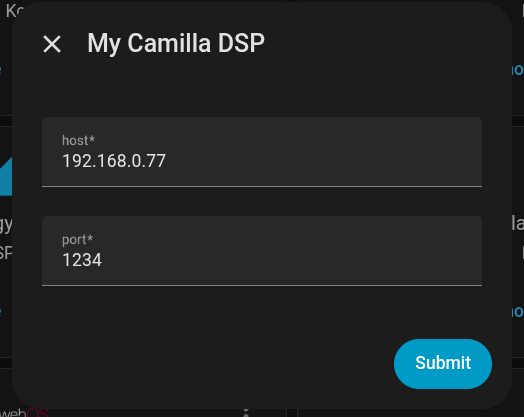
To connect to the CamillaDSP server, we need to know the host and port of the server. I could have hardcoded it, but anyway went with a config.py file.
from __future__ import annotations

import logging
from typing import Any

import voluptuous as vol

from homeassistant.config_entries import (
    ConfigEntry,
    ConfigFlow,
    ConfigFlowResult,
    OptionsFlow,
)
from homeassistant.const import (
    CONF_HOST,
    CONF_PORT,
)
from homeassistant.core import HomeAssistant, callback
from homeassistant.exceptions import HomeAssistantError

from .camilla_dsp_api import CamillaDspApi, APIConnectionError
from .const import DOMAIN

_LOGGER = logging.getLogger(__name__)

STEP_USER_DATA_SCHEMA = vol.Schema(
    {
        vol.Required(CONF_HOST, default="192.168.0.77", description={"suggested_value": "192.168.0.77"}): str,
        vol.Required(CONF_PORT, default="1234", description={"suggested_value": "1234"}): str,
    }
)


async def validate_input(hass: HomeAssistant, data: dict[str, Any]) -> dict[str, Any]:
    api = CamillaDspApi(data[CONF_HOST], data[CONF_PORT])
    try:
        api.connect()
    except APIConnectionError as err:
        raise CannotConnect from err
    return {"title": f"Camilla DSP - {data[CONF_HOST]}:{data[CONF_PORT]}"}


class CamillaDspConfigFlow(ConfigFlow, domain=DOMAIN):
    VERSION = 1
    _input_data: dict[str, Any]

    @staticmethod
    @callback
    def async_get_options_flow(config_entry):
        return OptionsFlowHandler(config_entry)

    async def async_step_user(
        self, user_input: dict[str, Any] | None = None
    ) -> ConfigFlowResult:
        errors: dict[str, str] = {}

        if user_input is not None:
            try:
                info = await validate_input(self.hass, user_input)
            except CannotConnect:
                errors["base"] = "cannot_connect"
            except Exception:  # pylint: disable=broad-except
                _LOGGER.exception("Unexpected exception")
                errors["base"] = "unknown"

            if "base" not in errors:
                await self.async_set_unique_id(info.get("title"))
                self._abort_if_unique_id_configured()
                return self.async_create_entry(title=info["title"], data=user_input)

        return self.async_show_form(
            step_id="user", data_schema=STEP_USER_DATA_SCHEMA, errors=errors
        )


class OptionsFlowHandler(OptionsFlow):
    def __init__(self, config_entry: ConfigEntry) -> None:
        self.config_entry = config_entry
        self.options = dict(config_entry.options)

    async def async_step_init(self, user_input=None):
        if user_input is not None:
            options = self.config_entry.options | user_input
            return self.async_create_entry(title="", data=options)

        return self.async_show_form(step_id="init", data_schema=STEP_USER_DATA_SCHEMA)


class CannotConnect(HomeAssistantError):
I copied most of the code from https://github.com/msp1974/HAIntegrationExamples/blob/main/msp_integration_101_template/README.md. But if you write a basic __init.py__ file, you can now install the integration in Home Assistant and configure it. For debugging, I was monitoring the Home Assistant logs which you get to see in the terminal where you are running podman compose up.
Another way to see only the logs from your integration is to add the following lines to home_assistant/configuration.yaml and restarting Home Assistant.
logger:
  default: info
  logs:
    custom_components.my_camilladsp: debug
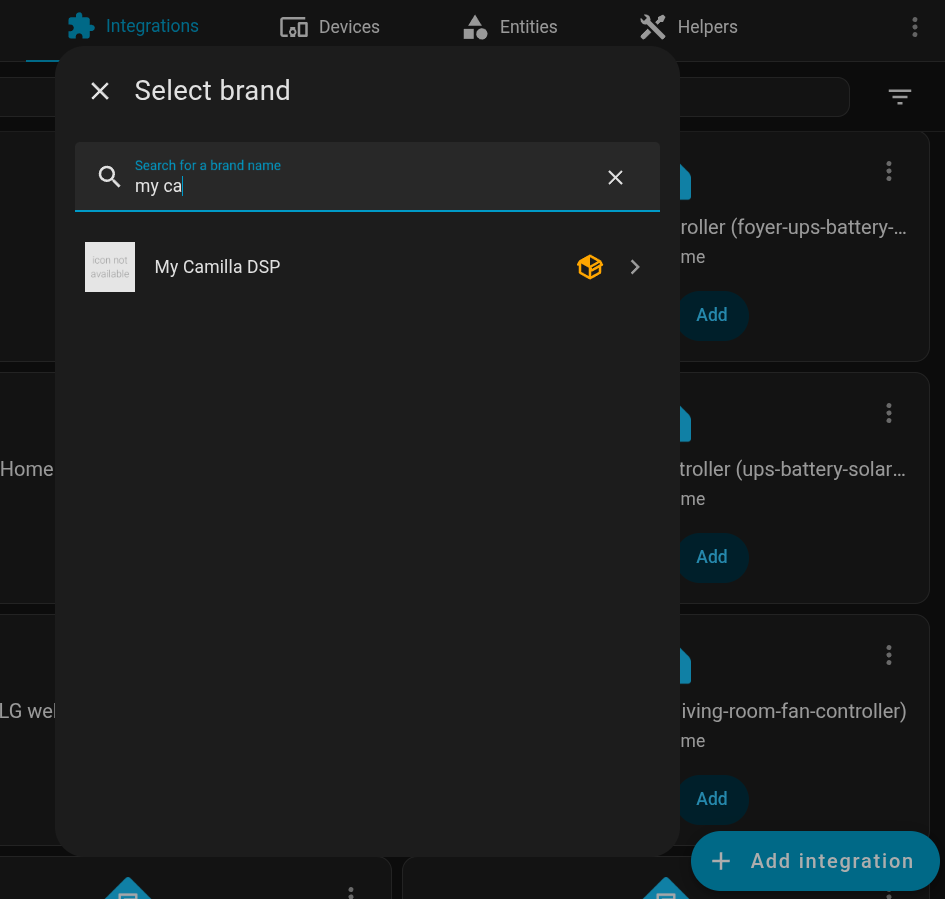
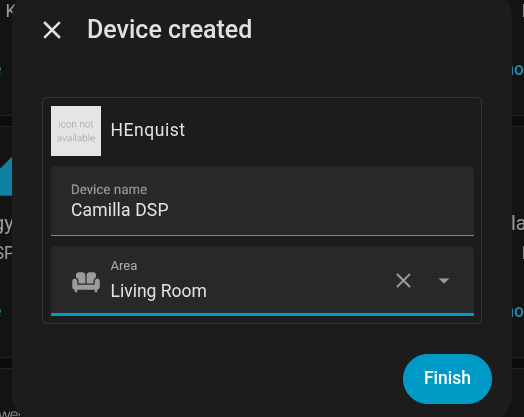
Remember to change my_camilladsp with your package directory. Then you can tail -F home-assistant.log | grep -i "camilla" to see your logs. Anyway, this is how the UI looks like when you add the integration in Home Assistant.
Next we need to add a proper __init__.py with the following content.
from __future__ import annotations

from collections.abc import Callable
from dataclasses import dataclass
import logging

from homeassistant.config_entries import ConfigEntry
from homeassistant.const import Platform
from homeassistant.core import HomeAssistant
from homeassistant.exceptions import ConfigEntryNotReady
from homeassistant.helpers.device_registry import DeviceEntry
from homeassistant.helpers.update_coordinator import DataUpdateCoordinator

from .coordinator import CamillaDspCoordinator

_LOGGER = logging.getLogger(__name__)

PLATFORMS = [
    Platform.MEDIA_PLAYER,
    Platform.NUMBER,
]

type MyConfigEntry = ConfigEntry[RuntimeData]


@dataclass
class RuntimeData:
    coordinator: DataUpdateCoordinator


async def async_setup_entry(hass: HomeAssistant, config_entry: MyConfigEntry) -> bool:
    coordinator = CamillaDspCoordinator(hass, config_entry)
    await coordinator.async_config_entry_first_refresh()
    if not coordinator.api.connected:
        raise ConfigEntryNotReady
    config_entry.async_on_unload(
        config_entry.add_update_listener(_async_update_listener)
    )
    config_entry.runtime_data = RuntimeData(coordinator)
    await hass.config_entries.async_forward_entry_setups(config_entry, PLATFORMS)
    return True


async def _async_update_listener(hass: HomeAssistant, config_entry):
    await hass.config_entries.async_reload(config_entry.entry_id)


async def async_remove_config_entry_device(
    hass: HomeAssistant, config_entry: ConfigEntry, device_entry: DeviceEntry
) -> bool:
    return True


async def async_unload_entry(hass: HomeAssistant, config_entry: MyConfigEntry) -> bool:
    return await hass.config_entries.async_unload_platforms(config_entry, PLATFORMS)
I am basically letting Home Assistant know that I am integrating a MEDIA_PLAYER and NUMBER entities. The media player entity is the one that will let me switch the config files from music to movie etc. The number entities will let me change the bass and treble configuration in CamillaDSP. Now comes the meat of the integration which is the class that makes the API calls to CamillaDSP server camilla_dsp_api.py.
import logging
from enum import StrEnum

from homeassistant.components.media_player import MediaPlayerState

from .camilladsp.camilladsp import CamillaClient
from .camilladsp.general import ProcessingState


_LOGGER = logging.getLogger(__name__)


class CamillaDspConfig(StrEnum):
    DEFAULT = "default"
    MUSIC = "music"
    MOVIE = "movie"


class CamillaDspEq(StrEnum):
    BASS = "Bass"
    TREBLE = "Treble"


class CamillaDspApi:
    def __init__(self, host: str, port: str) -> None:
        self.host = host
        self.port = port
        self.connected: bool = False
        self.client = CamillaClient(self.host, self.port)

    @property
    def controller_name(self) -> str:
        return self.host.replace(".", "_")

    def connect(self) -> bool:
        camilla_dsp_info = "CamillaDSP (" + self.host + ":" + self.port + ")"
        _LOGGER.debug("Connecting to " + camilla_dsp_info)
        try:
            self.client.connect()
            _LOGGER.info("Connected to " + camilla_dsp_info)
            self.connected = True
            return True
        except Exception as e:
            _LOGGER.error("Failed to connect to " + camilla_dsp_info)
            raise APIConnectionError("Unable to connect to " + camilla_dsp_info)

    def disconnect(self) -> bool:
        camilla_dsp_info = "CamillaDSP (" + self.host + ":" + self.port + ")"
        _LOGGER.debug("Disconnecting from " + camilla_dsp_info)
        self.client.disconnect()
        self.connected = False
        return True

    def get_state(self) -> str:
        state = MediaPlayerState.OFF
        match self.client.general.state():
            case ProcessingState.INACTIVE:
                state = MediaPlayerState.STANDBY
            case ProcessingState.PAUSED:
                state = MediaPlayerState.PAUSED
            case ProcessingState.RUNNING:
                state = MediaPlayerState.PLAYING
            case ProcessingState.STALLED:
                state = MediaPlayerState.IDLE
            case ProcessingState.STARTING:
                state = MediaPlayerState.ON
        return state

    def get_volume(self) -> float:
        return self.client.volume.main_volume()

    def set_volume(self, volume: float):
        self.client.volume.set_main_volume(volume)
        self._volume = volume

    def get_mute(self) -> bool:
        return self.client.volume.main_mute()

    def set_mute(self, mute: bool):
        self.client.volume.set_main_mute(mute)
        self._mute = mute

    def get_source(self) -> str:
        source = self.client.config.file_path()
        if source.endswith("music.yml"):
            return CamillaDspConfig.MUSIC
        elif source.endswith("movie.yml"):
            return CamillaDspConfig.MOVIE
        else:
            return CamillaDspConfig.DEFAULT

    def set_source(self, source: str) -> None:
        base = "/storage/workspace/camilladsp/configs/"
        match source:
            case CamillaDspConfig.MUSIC:
                self.client.config.set_file_path(base + "51-rew-80hz-music.yml")
            case CamillaDspConfig.MOVIE:
                self.client.config.set_file_path(base + "51-rew-80hz-movie.yml")
            case _:
                self.client.config.set_file_path(base + "51-rew-80hz.yml")
        self.client.general.reload()

    def get_sources(self) -> list[str]:
        return [CamillaDspConfig.DEFAULT, CamillaDspConfig.MUSIC, CamillaDspConfig.MOVIE]

    def get_eq(self) -> dict[CamillaDspEq, float]:
        config = self.client.config.active()
        return {
            CamillaDspEq.BASS: config["filters"][CamillaDspEq.BASS]["parameters"]["gain"],
            CamillaDspEq.TREBLE: config["filters"][CamillaDspEq.TREBLE]["parameters"]["gain"]
        }

    def set_eq(self, filter, db_value):
        config = self.client.config.active()
        config["filters"][filter]["parameters"]["gain"] = db_value
        self.client.config.set_active(config)

class APIConnectionError(Exception):
For details about the API, see the pyCamillaDSP documentation. Next we have coordinator.py which updates the local state with data from CamillaDSP.
from dataclasses import dataclass
from datetime import timedelta
import logging

from homeassistant.config_entries import ConfigEntry
from homeassistant.const import (
    CONF_HOST,
    CONF_PORT,
)
from homeassistant.core import DOMAIN, HomeAssistant
from homeassistant.helpers.update_coordinator import DataUpdateCoordinator, UpdateFailed

from .camilla_dsp_api import CamillaDspApi, APIConnectionError, CamillaDspEq

_LOGGER = logging.getLogger(__name__)


@dataclass
class CamillaDspData:
    state: str
    volume: float
    mute: bool
    source: str
    source_list: list[str]
    eq: dict[CamillaDspEq, float]


class CamillaDspCoordinator(DataUpdateCoordinator):
    data: CamillaDspData

    def __init__(self, hass: HomeAssistant, config_entry: ConfigEntry) -> None:
        self.host = config_entry.data[CONF_HOST]
        self.port = config_entry.data[CONF_PORT]
        self.poll_interval = 10
        super().__init__(
            hass,
            _LOGGER,
            name=f"{DOMAIN} ({config_entry.unique_id})",
            update_method=self.async_update_data,
            update_interval=timedelta(seconds=self.poll_interval),
        )

        # Initialise your api here
        self.api = CamillaDspApi(host=self.host, port=self.port)

    async def async_update_data(self):
        try:
            if not self.api.connected:
                self.api.connect()
            state = self.api.get_state()
            volume = self.api.get_volume()
            mute = self.api.get_mute()
            source = self.api.get_source()
            sources = self.api.get_sources()
            eq = self.api.get_eq()
        except APIConnectionError as err:
            _LOGGER.error(err)
            raise UpdateFailed(err) from err
        except Exception as err:
            raise UpdateFailed(f"Error communicating with API: {err}") from err
        return CamillaDspData(state, volume, mute, source, sources, eq)
Home Assistant will be calling async_update_data every 10 seconds (poll_interval) and we connect to camillaDSP and fetch the current state and store that information locally. Next I created a base class entity.py for all the entities that belong to this integration.
from homeassistant.helpers.update_coordinator import CoordinatorEntity
from homeassistant.helpers.device_registry import DeviceInfo

from .coordinator import CamillaDspCoordinator, CamillaDspData
from .const import (
    DOMAIN,
    NAME,
)

class CamillaDspEntity(CoordinatorEntity):
    def __init__(
        self,
        unique_id: str,
        coordinator: CamillaDspCoordinator,
    ) -> None:
        super().__init__(coordinator)
        self._attr_has_entity_name = True
        self._attr_unique_id = unique_id
        self._attr_device_info = DeviceInfo(
            identifiers={(DOMAIN, str(self.unique_id))},
            name=NAME,
            manufacturer="HEnquist",
            model="",
        )
        self._data: CamillaDspData = self.coordinator.data
Now for the UI side of Home Assistant. I added a media_player.py entity that allows me to change the master volume of CamillaDSP and the configs.
import logging

import voluptuous as vol

from homeassistant.components.media_player import (
    MediaPlayerDeviceClass,
    MediaPlayerEntity,
    MediaPlayerEntityDescription,
    MediaPlayerEntityFeature,
    MediaPlayerState,
    MediaType,
)
from homeassistant.core import HomeAssistant, callback
from homeassistant.helpers.entity_platform import AddEntitiesCallback

from . import MyConfigEntry
from .coordinator import CamillaDspCoordinator
from .entity import CamillaDspEntity

_LOGGER = logging.getLogger(__name__)

ENTITY_DESC = MediaPlayerEntityDescription(
    key="mediaplayer",
    translation_key="mediaplayer",
)


async def async_setup_entry(hass: HomeAssistant,
                            config_entry: MyConfigEntry,
                            async_add_entities: AddEntitiesCallback) -> None:
    # This gets the data update coordinator from the config entry runtime data as specified in your __init__.py
    coordinator: CamillaDspCoordinator = config_entry.runtime_data.coordinator
    entities = []
    entities.append(CamillaDspMediaPlayer(config_entry.entry_id, coordinator, ENTITY_DESC))
    async_add_entities(entities, update_before_add=False)


class CamillaDspMediaPlayer(CamillaDspEntity, MediaPlayerEntity):  # type: ignore[misc]
    _attr_media_content_type = MediaType.MUSIC
    _attr_device_class = MediaPlayerDeviceClass.RECEIVER
    _attr_supported_features = (
        MediaPlayerEntityFeature.VOLUME_MUTE |
        MediaPlayerEntityFeature.VOLUME_SET |
        MediaPlayerEntityFeature.SELECT_SOURCE
    )
    _attr_source_list = []

    entity_description = MediaPlayerEntityDescription

    def __init__(
        self,
        unique_id: str,
        coordinator: CamillaDspCoordinator,
        description: MediaPlayerEntityDescription,
    ) -> None:
        super().__init__(unique_id, coordinator)
        self._attr_name = None
        self.entity_description = description
        self._set_attrs_from_data()

    @callback
    def _handle_coordinator_update(self) -> None:
        self._data = self.coordinator.data
        self._set_attrs_from_data()
        super()._handle_coordinator_update()

    def _set_attrs_from_data(self):
        if self._data is not None:
            self._attr_available = self._data.state
            self._attr_state = self._data.state
            self._attr_volume_level = self._convertFromDb(self._data.volume)
            self._attr_is_volume_muted = self._data.mute
            self._attr_source = self._data.source
            self._attr_source_list = self._data.source_list
        else:
            self._attr_available = MediaPlayerState.OFF

    def _convertFromDb(self, volume: float) -> float:
        return round((50 + volume) / 50, 2)

    @callback
    def _update_attrs_write_ha_state(self) -> None:
        self._set_attrs_from_data()
        self.async_write_ha_state()

    def available(self) -> bool:
        return self._attr_available

    async def async_set_volume_level(self, volume: float) -> None:
        volume_db = self._convertToDb(volume)
        await self.async_set_volume_level_db(volume_db)

    def _convertToDb(self, volume: float) -> float:
        return round((volume * 50 - 50), 2)

    async def async_set_volume_level_db(self, volume_db: float) -> None:
        self.coordinator.api.set_volume(volume_db)
        self._data.volume = volume_db
        self._update_attrs_write_ha_state()

    async def async_mute_volume(self, mute: bool) -> None:
        self.coordinator.api.set_mute(mute)
        self._data.mute = mute
        self._update_attrs_write_ha_state()

    async def async_select_source(self, source: str) -> None:
        self.coordinator.api.set_source(source)
        self._data.source = source
        self._update_attrs_write_ha_state()
What I am letting Home Assistant (HA) know is that this media player is capable of changing volume (MediaPlayerEntityFeature.VOLUME_SET), can be muted or un-muted (MediaPlayerEntityFeature.VOLUME_MUTE) and it can change source (MediaPlayerEntityFeature.SELECT_SOURCE). Basically, changing the source is what causes the CamillaDSP to change the config files (music or movie). When HA calls the relevant methods, I simply call the API to CamillaDSP to do the appropriate thing. I do the same thing in number.py which controls the bass and treble settings.
import logging

from homeassistant.components.number import NumberEntity, NumberMode, NumberDeviceClass
from homeassistant.const import EntityCategory
from homeassistant.core import HomeAssistant, callback
from homeassistant.helpers.entity_platform import AddEntitiesCallback

from . import MyConfigEntry
from .camilla_dsp_api import CamillaDspEq
from .coordinator import CamillaDspCoordinator
from .entity import CamillaDspEntity

_LOGGER = logging.getLogger(__name__)


async def async_setup_entry(hass: HomeAssistant,
                            config_entry: MyConfigEntry,
                            async_add_entities: AddEntitiesCallback) -> None:
    coordinator: CamillaDspCoordinator = config_entry.runtime_data.coordinator
    entities = []
    entities.append(CamillaDspEqEntity(config_entry.entry_id, coordinator, CamillaDspEq.BASS))
    entities.append(CamillaDspEqEntity(config_entry.entry_id, coordinator, CamillaDspEq.TREBLE))
    async_add_entities(entities, update_before_add=False)


class CamillaDspEqEntity(CamillaDspEntity, NumberEntity):
    _attr_entity_category = EntityCategory.CONFIG

    def __init__(
        self,
        unique_id: str,
        coordinator: CamillaDspCoordinator,
        type: CamillaDspEq,
    ) -> None:
        super().__init__(unique_id, coordinator)
        self._attr_unique_id = f"{unique_id}-{type}"
        self._attr_name = type
        self._attr_native_min_value, self._attr_native_max_value = [-12, 12]
        self._attr_native_step = 0.5
        self._attr_mode = NumberMode.SLIDER
        self._attr_device_class = NumberDeviceClass.SOUND_PRESSURE
        self. _attr_native_unit_of_measurement = "db"
        self.type = type;
        self._set_attrs_from_data()

    def _set_attrs_from_data(self):
        self._attr_native_value = self._data.eq[self.type]

    @callback
    def _handle_coordinator_update(self) -> None:
        self._data = self.coordinator.data
        self._set_attrs_from_data()
        super()._handle_coordinator_update()

    async def async_set_native_value(self, value: float) -> None:
        self.coordinator.api.set_eq(self.type, value)
        self._attr_native_value = value
        self.async_write_ha_state()
Here I am creating 2 entities (CamillaDspEq.BASS, CamillaDspEq.TREBLE) of the type configuration (EntityCategory.CONFIG). Whenever the values are changed in HA UI, the async_set_native_value will be called and I simply call the relevant CamillaDSP API to apply the filters. That is it. After this we have a fully functioning integration.
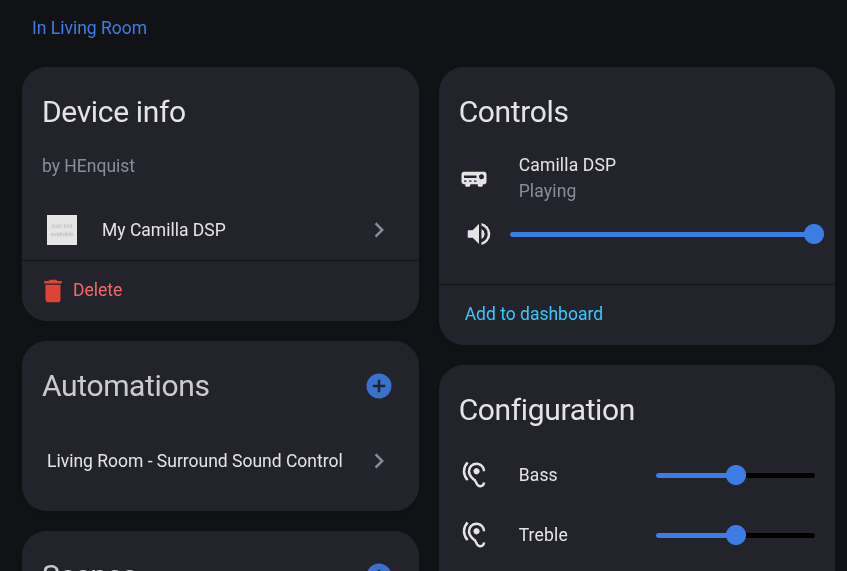
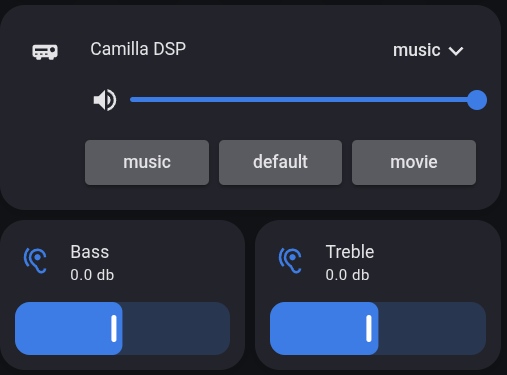
This how it looks like in my Home Assistant UI with mini media player card.
References
- https://github.com/HEnquist/camilladsp
- https://github.com/HEnquist/camillagui-backend
- https://github.com/mdsimon2/RPi-CamillaDSP
- https://www.roomeqwizard.com/
- https://www.youtube.com/watch?v=tLUClxjUTC4
- https://www.youtube.com/watch?v=O8YpPSXKzuE
- https://github.com/kwerner72/homeassistant-camilladsp